Most students who study a language for years in a traditional classroom still struggle to hold a simple conversation. They can recite grammar rules and pass written tests – but the moment they need to actually speak, something breaks down. This is not a student problem. It is a method problem.
Immersion language learning flips that model entirely. Instead of studying a language as a subject, students live inside it. It gets woven into science lessons, social interactions, storytelling, and daily routines. And the results are measurably different. Schools around the world – including international schools in the UAE like Rawafed School – are moving toward this approach because it reflects how language is actually acquired: through use, not memorization.
What Is Immersive Language Learning in Education?
Immersion-based language learning means using the target language as the primary vehicle for delivering academic content. A math teacher explains fractions in Arabic. A science lesson on ecosystems happens in English. The language itself becomes the tool students reach for because it is the only one available in that context.
What is immersive language learning when you strip away the theory? It is consistent, meaningful exposure. It is being surrounded by a language so regularly that the brain stops translating and starts processing directly.
This is fundamentally different from traditional language classes, where the focus is on grammar structures, vocabulary lists, and written exercises. Those methods build knowledge about a language. Immersion builds the ability to use one
Core Idea Behind Language Immersion Schools
Language immersion schools organize their curriculum around the principle that fluency develops through authentic communication, not through drills. The assumption is simple: children did not learn their first language by studying textbooks. They learned it by being surrounded by speakers, by needing to communicate, and by making mistakes without penalty.
Language immersion schools try to recreate that environment in a formal educational setting. The structure varies – some schools deliver all academic content in a second language, others split time between two languages – but the underlying logic stays the same. Repetition through real use beats repetition through rote learning, every time.
How Language Immersion Schools Structure Learning
How a school designs its immersion program matters enormously. The same core idea can produce very different experiences depending on how much of the school day is actually spent in the target language.
Language immersion schools typically choose from two main approaches.
Full Immersion vs Partial Immersion Models
| Model | Target Language Use | Best Suited For |
| Full Immersion | 90–100% of the school day | Early childhood, bilingual flagship programs |
| Partial Immersion | 50–70% of the school day | Mixed-language schools, transitional programs |
| Content and Language Integrated Learning (CLIL) | Subject-specific delivery | International curricula, multilingual schools |
In a full immersion setting, students are expected to communicate entirely in the target language from day one. Teachers may use gestures, visuals, and context to help students understand – but they do not fall back on the students’ home language. This model tends to produce strong oral fluency, particularly when started early.
Partial immersion splits instruction across two languages. A student might receive mathematics, science, and social studies in English, while Arabic or another language is used for humanities or cultural subjects. This approach suits schools that want to maintain academic strength across two languages without overwhelming students – and it reflects how many international schools in the UAE operate.
Classroom Environment in a Foreign Language Immersion School
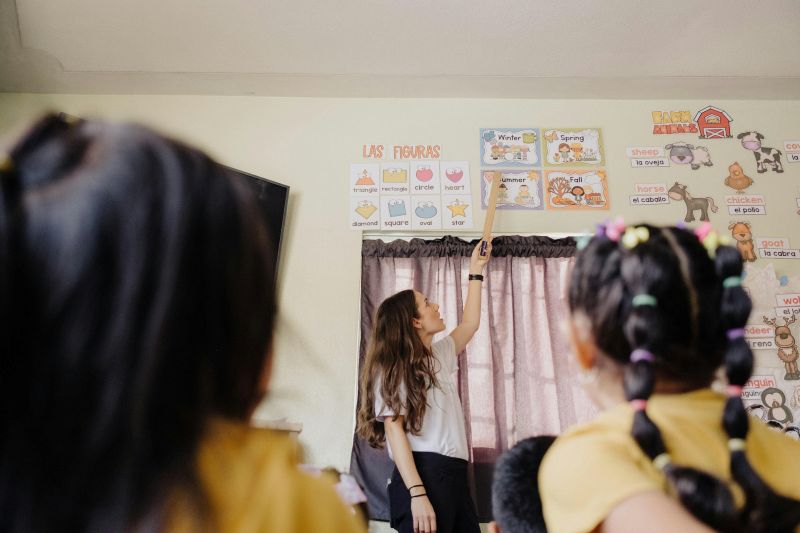
A foreign language immersion school classroom looks and feels different from a standard language class. The environment itself is designed to communicate meaning – not just the teacher. Several consistent features define these spaces:
- Labeled visual displays – walls covered with diagrams, vocabulary charts, and student work, all in the target language
- Language-embedded routines – everyday actions like lining up, asking questions, and giving instructions happen entirely in the target language
- Bilingual reference materials – accessible charts and word walls that help students connect new terms to concepts they already understand
- Student-produced content – project work, posters, and written pieces displayed in the language being learned, reinforcing that the language belongs to the students, too
Why Schools Use Immersion Language Learning for Better Fluency
The case for immersion is not simply theoretical – the research record is substantial. A 2025 comparative study published in the Global Academy of Peer Bodhitaru Research journal directly contrasted immersion program participants with conventional ESL students across multiple proficiency measures. The findings were clear: immersion learners demonstrated markedly stronger listening comprehension and spoken fluency, and developed more natural conversational strategies and greater linguistic flexibility than their traditionally-taught peers.
Supporting this, a 2024 review published in the American Journal of Humanities and Social Sciences Research confirmed that the benefits of early immersion programs persist over time, producing consistently better outcomes than conventional language instruction — with the key variable being how early and how extensively students are exposed to the target language.
What drives these results? Several factors:
- Volume of exposure – students interact with the language for hours each day, not 45 minutes once a week
- Authentic context – language is used to accomplish real academic tasks, not practice exercises
- Reduced cognitive switching – when students cannot default to their native language, the brain adapts and begins processing in the target language more naturally
- Social integration – peer communication in the target language reinforces what is learned in class
How Immersive Language Learning Works in Practice
The day-to-day mechanics of immersive language learning differ significantly depending on the subject, the teacher, and the level of instruction. But certain patterns show up consistently across well-run programs.

Subject-Based Language Integration
Rather than carving out a separate “language period,” immersive programs embed the language into science, math, social studies, and the arts. A student learning about the water cycle in English is simultaneously building scientific vocabulary – not because a teacher listed those words on a whiteboard, but because they were needed to understand the lesson.
This plays out across the school day in predictable ways:
- Science lessons use the target language to explain processes, prompting students to ask questions, form hypotheses, and discuss results — all in real time
- Math instruction introduces numerical reasoning through verbal explanation, building both procedural fluency and the language to describe it
- Social studies and humanities create opportunities for discussion, debate, and opinion-sharing, which require a broader range of communicative language
- Arts and project-based work give students creative space to produce language in low-stakes, meaningful contexts
This method is sometimes called Content and Language Integrated Learning (CLIL), and it is a central strategy in many international school curricula at Rawafed School. The content gives students a reason to use the language. The language gives them a way to access the content. The two reinforce each other in a way no grammar worksheet can replicate.
Role of Teachers in Immersion Classrooms
Teachers in a foreign language immersion school need a specific skillset. Their job is not just to teach a subject – it is to model fluent, natural language use while making academic content accessible to students who may still be developing comprehension in that language.
Effective immersion teachers rely heavily on:
- Visual scaffolding – diagrams, images, and real objects that give language its meaning
- Repetition through routine – using the same phrases day after day until they become automatic
- Comprehensible input – pitching language slightly above what students can produce, but within what they can understand
- Feedback through correction – gently restating a student’s error in correct form rather than stopping the conversation to lecture about grammar
The teacher’s consistency is what holds the immersive environment together. The moment they slip into the student’s native language to “explain something quickly,” the immersion breaks.
Student Interaction and Peer Learning
One of the most underestimated drivers of fluency in immersive language learning is what happens between students. Peer interaction – working in groups, giving presentations, debating ideas, collaborating on projects – requires spontaneous language production. It is messy, imperfect, and enormously effective.
Students correct each other. They negotiate meaning. They find ways to say what they want to say with the vocabulary they actually have. Schools typically create this kind of peer interaction through:
- Group projects that require students to divide tasks, share findings, and present conclusions in the target language
- Collaborative problem-solving activities where students must explain their reasoning to each other, not just arrive at an answer
- Structured discussion formats such as think-pair-share, where every student produces language, not just the most confident speakers
- Informal peer communication during transitions, play, or shared activities – moments that build natural fluency without the pressure of formal assessment
Schools that create genuine reasons for students to talk to each other in the target language accelerate fluency faster than those that limit production to teacher-directed activities.
Use of Visual and Contextual Learning Tools
Context is the bridge between language and meaning. When students cannot yet understand words alone, visuals carry the load. A well-designed immersion classroom uses charts, illustrations, videos, physical objects, and student-created displays to anchor the target language to real things.
Learn more about how Rawafed School integrates contextual learning tools across its immersive academic program. This contextual grounding is particularly important in the early stages, when comprehension is still fragile, and students depend heavily on non-verbal cues to make sense of what they hear.

The Lasting Impact of Language Immersion on Academic and Social Development
Immersion language learning does not just build fluency in a second language – it reshapes how students engage with learning overall. Research consistently shows that students in immersion programs develop stronger metalinguistic awareness, meaning they understand how language works at a deeper level. That understanding transfers. Bilingual students often show stronger reading comprehension and problem-solving skills, even in their native language.
The broader academic benefits worth noting include:
- Stronger cognitive flexibility – switching between languages trains the brain to manage competing information more effectively
- Higher metalinguistic awareness – students become more analytical about grammar, structure, and meaning across both languages
- Better reading comprehension – in many studies, immersion students outperform monolingual peers on reading tasks even in their native tongue
- Greater cultural sensitivity – language learned through authentic interaction develops an understanding of when and why to say something, not just how
Modern international schools, including those in the UAE, are building programs around this principle because parents and educators alike are recognizing that grammar tests cannot measure what a student will actually be able to do with a language in real life. Explore Rawafed School’s approach to multilingual education to see how this commitment to immersive learning shapes the school’s educational identity.
Frequently Asked Questions
What is the difference between immersion language learning and a regular language class?
In a regular language class, language is the subject being studied – students learn rules, vocabulary, and grammar in structured exercises. In immersion language learning, language is the tool used to teach everything else. Students learn math, science, and social studies through the target language, producing far more natural and sustained exposure.
At what age is immersion language learning most effective?
Early childhood is the most productive window, largely due to the brain’s heightened plasticity in those years. Children who begin immersion programs in kindergarten often achieve near-native fluency by age ten or eleven. Older students also benefit – particularly in structured academic immersion settings.
Can a student fall behind in other subjects while adjusting to an immersion program?
Research consistently shows that core academic performance is not harmed by immersion instruction. Studies by Swain and Lapkin found that French immersion students in Canada kept pace with peers in math and science even when those subjects were taught entirely in their second language.
How long does it take for immersion language learning to produce real fluency?
It depends on the student’s age, program intensity, and the distance between their native and target language. In well-structured early programs, conversational fluency typically develops within two to three years, while academic language proficiency takes somewhat longer.
What makes a school truly count as a language immersion school?
A language immersion school delivers at least 50% of its academic curriculum in the target language. This sets it apart from schools that offer language as an add-on subject. True immersion means students use the language to access content – not just study it separately.