Student teamwork improves learning outcomes because it turns quiet listening into active thinking. When students talk through a problem together, they have to explain their reasoning out loud, listen to a different point of view, and catch mistakes before a project is finished – something that rarely happens when someone studies alone. Schools that build steady teamwork for students into daily lessons, not just occasional group projects, tend to see the payoff in more than test scores. Students communicate better, argue their points more clearly, and carry those habits into other subjects.
What follows looks at why collaboration has become such a valued skill in modern classrooms, what actually separates real teamwork from students simply sitting near each other, and how an American curriculum school such as Rawafed School turns it into daily practice.
Why Collaboration Has Become One of the Most Valuable Skills in Modern Education
Ask any teacher what separates a student who does well on paper from one who thrives long after graduation, and the answer rarely comes down to memorization. It comes down to how well a student can think alongside other people. Collaboration is linked again and again to stronger academic performance, sharper social skills, and steadier personal growth, because working with others forces a student to test ideas against reality instead of just against a textbook.
A scoping review published in the Review of Education journal found that collaborative and cooperative approaches consistently strengthen students’ sense of responsibility and their ability to work through complex problems, across subjects ranging from science to physical education. That is one reason so many schools now build teamwork activities for students directly into lesson plans rather than leaving collaboration to chance.
American curriculum schools tend to build this into the structure of the school day itself. Instead of treating group work as an occasional break from lectures, classrooms are designed around inquiry-based learning, open discussion, and hands-on projects where students are expected to contribute, question, and build on each other’s ideas. Participation is not a bonus; it is part of how the material gets learned in the first place.
What Is Student Teamwork?
It is the shared effort of a group of learners working toward one goal, where every contribution shapes the outcome, and no single student carries the project alone.
Teamwork vs. Simply Working in Groups
Sitting in a circle with three classmates is not the same as functioning as a team, and the difference matters more than it sounds.
|
Working in a Group |
Real Teamwork |
|
Tasks are split and done separately |
Tasks are discussed and adjusted together |
|
One student often does most of the work |
Responsibility is shared and visible |
|
Little talk beyond logistics |
Ongoing exchange of ideas and feedback |
|
Success depends on individual effort |
Success depends on how well the group coordinates |
Groups that only divide tasks rarely build the skills real collaboration is meant to teach. Genuine teamwork means shared accountability, not just shared space.
Why Teamwork Leads to Better Learning Outcomes
The academic gains are not accidental. They come from specific mental habits that group work naturally builds over time.
Improves Understanding Through Peer Discussion
Explaining an idea to a classmate forces a student to organize that idea clearly enough for someone else to follow, which is a tougher test than simply recognizing the right answer on a quiz. A 2025 study in Frontiers in Psychology on college classrooms found that collaborative learning activities were closely tied to stronger peer support, which in turn related to greater engagement with the material. Research along these lines suggests that teamwork students often retain material better than peers who study the same content in isolation, especially on tasks that call for judgment rather than recall.
Builds Critical Thinking and Decision-Making Skills
Group projects rarely have one obvious answer, and that is exactly the point. Students have to weigh options, defend a position, and sometimes change their mind when a teammate makes a better argument. That back-and-forth builds habits such as:
- Comparing evidence before settling on a conclusion
- Recognizing weak arguments, including their own
- Deciding within a time limit
- Adjusting a plan once new information comes in
Increases Classroom Engagement and Motivation
A meta-analysis of cooperative learning in physical education classes found measurable gains in outcomes once lessons were restructured around cooperative tasks instead of individual drills. Motivation tends to rise once a student feels responsible to teammates, not only to a grade.
Teamwork Activities for Students That Promote Meaningful Learning
Good teamwork activities for students share one trait: every member has a real reason to stay involved from start to finish.
- Project-based learning challenges – students design a solution to an open-ended problem, from a school garden layout to a small business plan, and present it as a group.
- STEM design projects – building a bridge model or coding a simple app requires constant back-and-forth between roles like designer, tester, and presenter.
- Classroom debates and discussions – assigning sides on a topic pushes students to research, listen, and respond on the spot.
- Collaborative research assignments – splitting a topic into parts that must be combined into one coherent report teaches both independence and coordination.
- Problem-solving competitions – timed challenges, from math relays to escape-room style puzzles, reward quick communication under pressure.
None of these activities work as intended if one student quietly finishes the whole task alone. The structure has to make shared effort the only realistic path to completion.
How American Curriculum Schools Foster Collaboration Among Students (Tailored to Rawafed School)
At Rawafed School, teamwork for students is not treated as an add-on activity between lessons – it is built into how the American curriculum gets delivered day to day.
Collaborative Learning as Part of the American Curriculum
The American curriculum is built around active participation rather than passive note-taking, which means group discussion, shared projects, and peer feedback show up in nearly every subject instead of a single “group work day.”
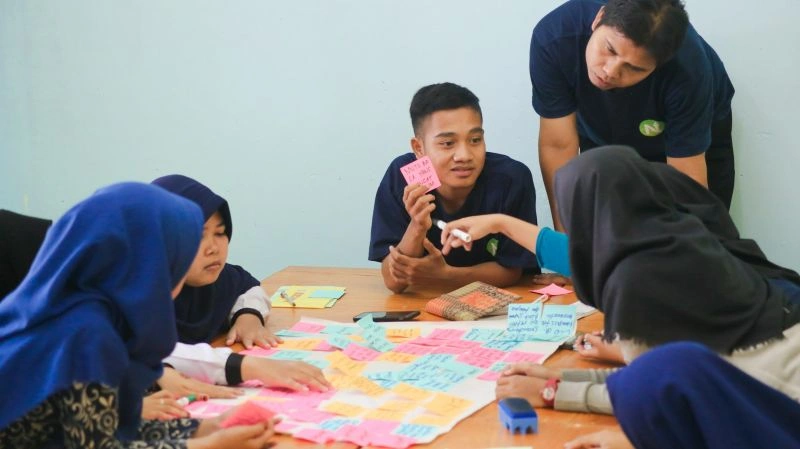
Inquiry-Based and Project-Based Classroom Experiences
Students at Rawafed School are regularly asked to investigate open questions rather than memorize fixed answers, and inquiry-based lessons naturally push them to compare notes, test ideas together, and refine their thinking as a team.
Student Leadership Opportunities Through Councils and School Initiatives
Leadership roles give collaboration skills a real setting outside the classroom. At Rawafed School, this takes several forms:
- A student council that plans events and represents classmates’ ideas
- Peer mentoring programs pairing older and younger students
- Committees organizing school-wide initiatives and drives
- Club leadership positions that rotate responsibility across members
Teamwork in STEM, Arts, Athletics, and Extracurricular Activities
Whether it is a robotics team troubleshooting a design flaw, a theater group rehearsing a scene, or a sports team adjusting strategy at halftime, the same core skill shows up across every extracurricular program: coordinating with others toward one shared result.
Building Global Citizenship Through Multicultural Collaboration
Working alongside classmates from different backgrounds teaches students to communicate across cultural lines, a skill that matters well beyond any single assignment. Many teamwork students at Rawafed School take part in multicultural projects and exchange-style activities that build this awareness directly, well before they ever leave the classroom.
Strong Teamwork Builds Stronger Learners
Group assignments are only the visible part of collaborative learning. The deeper value sits in what students carry with them afterward: the habit of listening before responding, the confidence to argue a point respectfully, and the patience to work through disagreement without shutting down.
A student who learns to negotiate roles on a science project is quietly practicing the same skills needed to lead a meeting years later. That is what makes teamwork students different from students who simply finish assignments: they leave school with habits that keep working long after the grade is recorded.
Frequently Asked Questions
Why is teamwork important for students?
Teamwork gives students practice explaining ideas, handling disagreement, and building on someone else’s thinking, which strengthens both understanding and communication at the same time.
What skills do students learn from teamwork?
Communication, negotiation, time management, and critical thinking all improve through regular group work, along with the confidence to speak up in a group setting.
How can teachers encourage better teamwork among students?
Clear roles, shared accountability, and tasks that genuinely require more than one person tend to work better than simply placing students in groups and hoping for the best.
What is the difference between teamwork and cooperation in the classroom?
Cooperation can mean students working side by side on separate parts of a task, while teamwork involves ongoing discussion and shared responsibility for the final result.
Does teamwork help shy or quiet students?
Structured group roles often give quieter students a defined way to contribute, which can build confidence that carries over into whole-class discussions.