The meta-analysis Is It Really a Neuromyth?, published in Frontiers in Psychology, Q3 2024, reviewed 21 studies with 1,712 participants and found that only 26% of learning outcomes showed the pattern needed to prove that students learn best when taught in their preferred style. Yet many parents still hear, “Your child is a visual learner,” and wonder whether every lesson should be built around pictures.
Learning styles are commonly used categories that describe how a person prefers to receive, process, or engage with information, such as a student who enjoys mind maps more than long written notes. Those preferences are real, and they can tell parents and teachers a lot about what keeps a child interested.
But a preference is not a fixed ability. Students learn best when they can work with information in several ways, and this guide explains the four familiar categories, what the research really shows, and how to help children become flexible, confident learners.

What Are Learning Styles, and Why Do They Matter in Education?
Learning styles describe the activities a student prefers, not necessarily the methods that help them learn most. That distinction matters: a child may enjoy watching videos about fractions, but practising problems and explaining their reasoning may build stronger understanding.
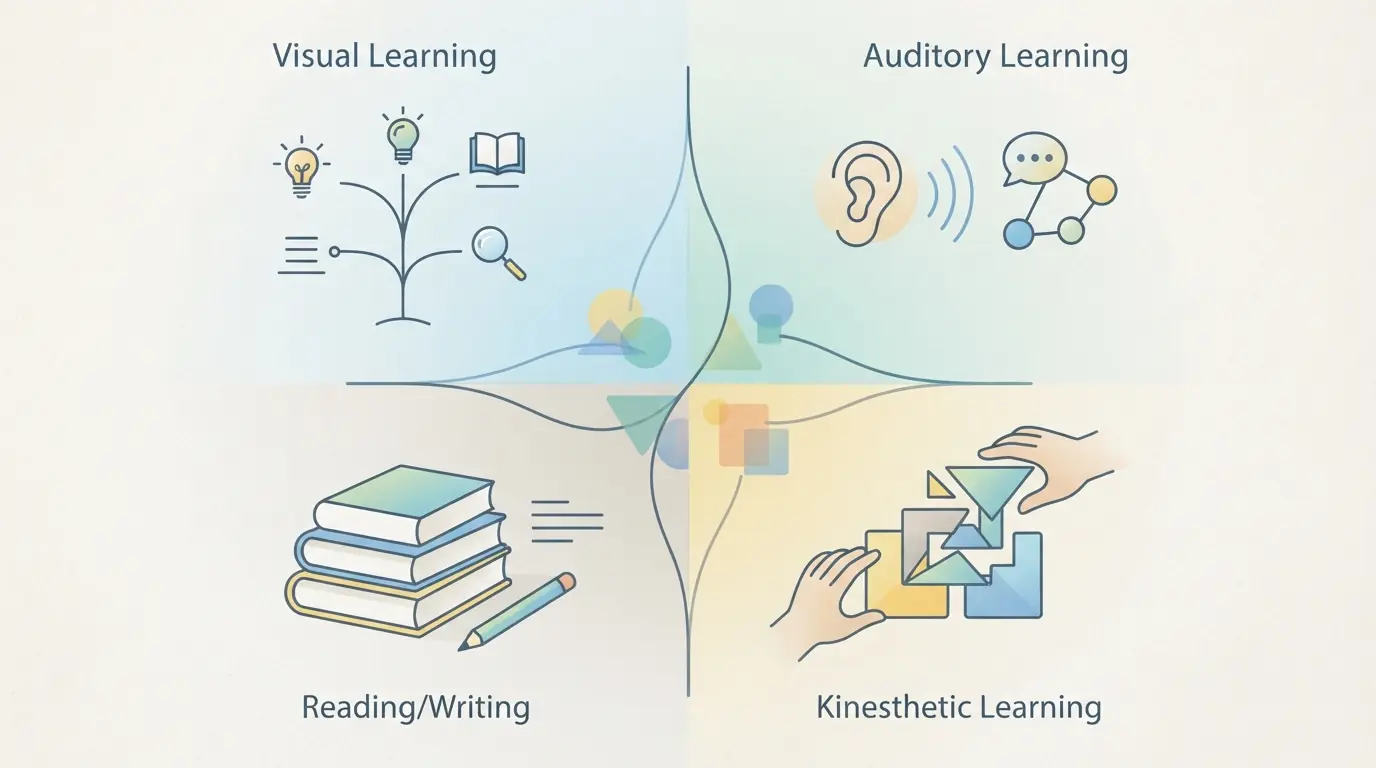
The most widely used model is VARK, which groups preferences into four categories: Visual, Auditory, Reading/Writing, and Kinesthetic. It gives parents and teachers a shared vocabulary for talking about the different learning styles of students and planning varied lessons.
What the Research Says About Learning Styles
Learning styles are popular in schools, but strong scientific evidence for matching teaching to a single style is limited. The 2024 Frontiers meta-analysis found a small overall benefit from matching, yet its authors concluded the effect was too small and inconsistent to justify building teaching around it. They pointed instead to multimodal teaching, combining words, visuals, and activities, as a better-supported approach for all students.
| Common Belief | What the Evidence Suggests |
|---|---|
| Every student has one dominant learning style | Most students have mixed preferences that change with the subject and task |
| Teachers must match lessons to each child’s style | Combining several approaches helps more students than matching one style |
| A “visual learner” can’t learn well from reading | Students can build skills in every format with practice |
| A learning style test reveals how a child should be taught | Preferences show interests, not fixed limits |
Limiting a student to one learning method can quietly limit what they learn. A child labelled “hands-on” who avoids reading misses the chance to build the reading skills every subject needs.
- Note: Preferences still matter. A student who feels comfortable with a task is often more motivated to start it. The goal is to use preferences as a way in, then gradually stretch into other approaches.
What Are the Four Main Types of Learning Styles in Students?
The four main types of learning styles in the VARK model are visual, auditory, reading/writing, and kinesthetic. Think of these different types of learning styles as a helpful way to describe learning activities, not as a test that sorts students into boxes.
1. Visual Learning: Understanding Through Images and Diagrams
Visual learning means making sense of information through images, layouts, and spatial organisation. Students who learn this way often enjoy diagrams, charts, and mind maps, find well-organised pages easier to follow, and like seeing a process illustrated while it is explained. In class, visual learning might look like:
- Using timelines to understand historical events
- Studying geography through maps
- Exploring scientific processes through labelled diagrams
- Creating mind maps to organise complex topics
Useful strategies: graphic organisers, concept maps, illustrated explanations, and visual demonstrations.
2. Auditory Learning: Engaging Through Listening and Discussion
Auditory learning centres on listening, speaking, and talking through ideas. These students often enjoy spoken explanations and storytelling, ask lots of questions, and take an active part in group conversations. In class, it might include:
- Discussing characters and themes in literature
- Debating historical events
- Explaining mathematical reasoning aloud
- Listening to a teacher model pronunciation in language lessons
Useful strategies: guided discussions, oral explanations, collaborative conversations, and chances to explain concepts aloud. Group work built on strong student teamwork gives these students natural opportunities to talk through ideas.
3. Reading/Writing Learning: Exploring Ideas Through Text
Reading/writing learning focuses on words on the page. These students often enjoy books, written instructions, and detailed notes, like organising information into lists and summaries, and prefer time to read and reflect before responding. Classroom examples include:
- Analysing reading passages in English lessons
- Writing summaries of historical events
- Preparing research reports
- Revising with study notes and written practice questions
Useful strategies: structured notes, reading assignments, written reflections, summaries, and practice questions.
4. Kinesthetic Learning: Learning Through Movement and Hands-On Activities
Kinesthetic learning involves doing, touching, and moving. These students often light up during experiments and interactive tasks, like testing ideas with real objects, and show greater engagement when lessons are active. In class, this might look like:
- Conducting science experiments
- Using manipulatives to explore maths concepts
- Building models in engineering or STEM lessons
- Taking part in educational role-play and simulations
Useful strategies: experiments, project-based learning, physical models, demonstrations, and practical problem-solving tasks.
Comparing the Different Kinds of Learning Styles
The different kinds of learning styles overlap far more than their labels suggest:
| Learning Style Category | Common Preference | Classroom Activity Example |
|---|---|---|
| Visual | Images and spatial representations | Diagrams and mind maps |
| Auditory | Listening and speaking | Discussion and storytelling |
| Reading/Writing | Written information | Reading and note-taking |
| Kinesthetic | Physical interaction and practical experience | Experiments and model building |
Most students benefit from all four approaches, and the strongest lessons usually combine several of them. A science lesson that includes a diagram, a class discussion, written notes, and a hands-on experiment reaches far more learners than any single method.
Why a Flexible Approach to Learning Matters for Academic Success
A flexible approach matters because real learning rarely happens in one format: maths needs reading, science needs discussion, and history needs visual timelines. Effective education responds to each student’s needs and interests without locking them into a single learning style.
What drives progress most is a set of habits that work across every format: curiosity, confidence, self-regulation, and independent study skills. A student who can plan their work, check their own understanding, and switch strategies when something isn’t working will do well whatever the lesson looks like.
Varied instruction also makes lessons more accessible. When teachers combine explanation, visuals, discussion, and practical tasks, more students find a way into the topic and feel ready to participate. Schools support this by blending traditional teaching, digital resources, practical experiences, and extracurricular learning, often through personalised learning that adapts to each student.
Practical Ways Parents Can Build Flexible Learning Habits at Home
Parents can help children become flexible learners with a few simple habits:
- Notice what your child enjoys, without labelling them. Say “You really like drawing diagrams” rather than “You’re a visual learner.”
- Revise the same topic in more than one way. Pair reading notes with drawing a mind map, explaining the idea aloud, or building a quick model.
- Ask your child to teach you. Explaining a topic in their own words shows what they truly understand and where the gaps are.
- Use practice questions, not just rereading. Testing themselves helps children remember far more than going over notes again.
- Build steady study routines. Short, regular sessions, like the ones in these calm study routines that reduce school stress, help children practise different strategies without pressure.
Tip: When your child says “I can’t learn this way,” try asking, “What would make this easier to start?” It keeps their preference in the conversation while still encouraging them to stretch.
These habits connect closely to supporting independent learning at home, because flexible learners are usually the ones who know how to manage their own study.
What Matters Most When Thinking About Learning Styles?
The most important goal is not discovering the one way a child must learn, but helping them develop the skills to learn successfully in many different situations. Students have different interests, strengths, and preferences, and those deserve attention. They just shouldn’t become limits.
Visual, auditory, reading/writing, and kinesthetic learning styles all have a place in a strong education, and lessons that combine them reach more students. For parents and teachers, the best guide is simple: watch for engagement, track real progress, and encourage study strategies that work.
Beyond Labels: How Does Your Child Learn Best?
Every student deserves more than a one-size-fits-all classroom, or a limiting label. Whether your child lights up during hands-on science labs, lively debates, or visual mapping, our teachers blend diverse teaching methods so students build real confidence across every subject.
Want to see multimodal learning in action?
Contact us to schedule a visit or chat with our academic team.
Frequently Asked Questions
Does my child’s learning style affect their academic performance?
A learning preference can affect how motivated your child feels, but research shows little evidence that matching lessons to one style raises grades. Study habits, practice, and steady strategies for academic success at school make a much bigger difference.
Can learning styles influence how my child performs on exams?
Exams mostly test knowledge and reasoning in written form, regardless of preference. Students who revise in several ways, such as practice questions, diagrams, and explaining topics aloud, are usually better prepared than those who rely on one method.
Are online learning platforms suitable for all types of learners?
Good platforms combine video, text, interactive tasks, and quizzes, so they can work well for most students. Children who need movement or discussion may benefit from mixing online study with hands-on activities and conversation.
Should teachers group students according to their learning styles?
Grouping students by learning style isn’t supported by strong evidence and can limit their development. Mixed groups that use varied activities give every student practice with different ways of learning.
Can extracurricular activities help my child discover new ways of learning?
Yes. Clubs, sports, music, and STEM activities let children practise listening, teamwork, problem-solving, and hands-on skills outside the classroom. They often reveal strengths that regular lessons don’t show.