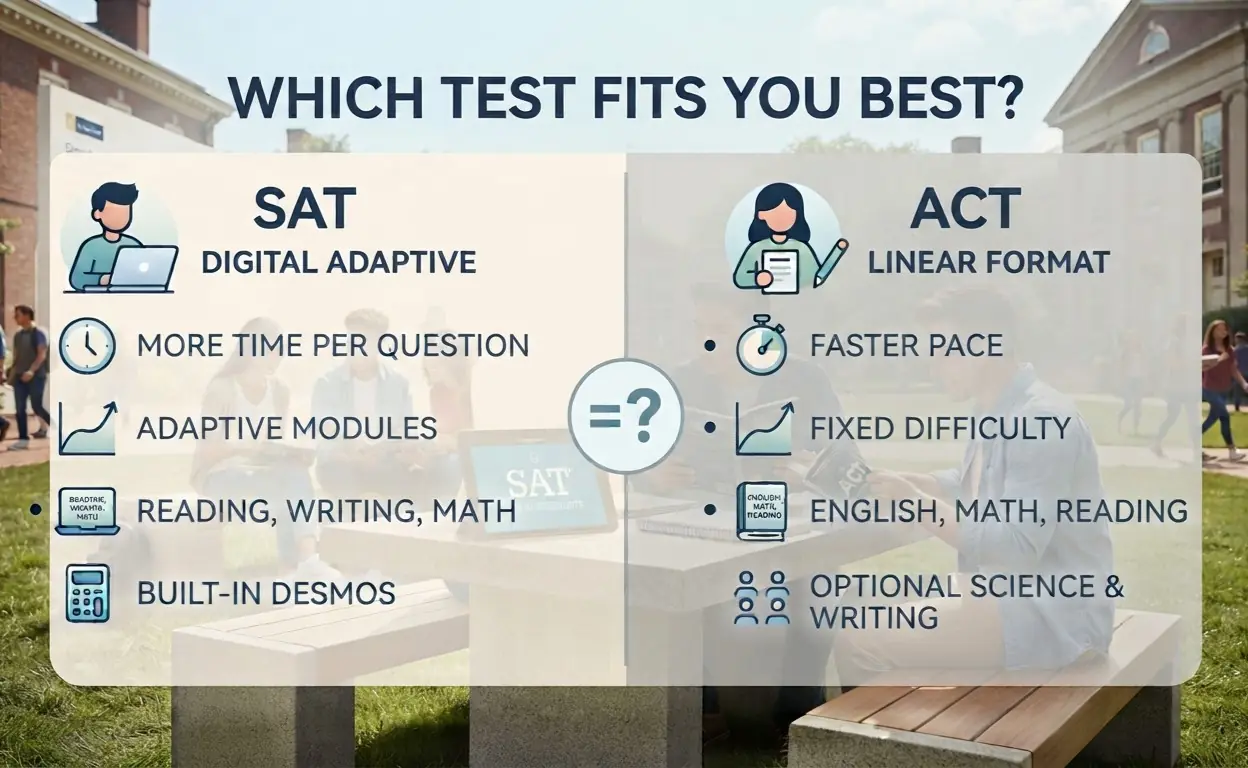
The main difference between ACT and SAT is format and pace: the digital SAT is an adaptive test with two sections and more time per question, while the ACT is a faster, linear test with English, Math, and Reading, plus optional Science and Writing. The College Board’s 2025 SAT Suite of Assessments Annual Report, Q3 2025, shows that more than 2 million students in the class of 2025 took the SAT, and 97% of them sat the digital version.
That shift matters. Both exams measure college readiness and are widely accepted by American universities, but the digital SAT and the enhanced ACT now look quite different from the versions many parents and older siblings remember. Advice like “the ACT has a science section” or “the SAT has a no-calculator math section” is simply out of date.
This guide compares the SAT and ACT as they work today, from structure and timing to scoring, and then turns those differences into a clear way to choose.
What Are the SAT and ACT Exams?
The SAT and ACT are standardised tests that US colleges and universities use to assess how ready a student is for university-level work. Scores can influence admission decisions, merit scholarships, and placement into first-year courses.
Testing policies vary widely. Some universities require scores, many are test-optional, and a few are test-free and won’t look at scores at all. Universities that accept both exams do not prefer one over the other, so the right choice is the test that shows your strengths best.
- Note: Always check the admissions page of every university on your list. Policies can change from one application year to the next, and some scholarships or programmes still expect a score even when admission is test-optional.
The Digital SAT: Adaptive Format and Two Sections
The SAT is a fully digital exam created and administered by the College Board. It has two main sections: Reading and Writing, and Math.
Each section is split into two modules. The SAT is adaptive, which means the difficulty of your second module depends on how well you performed in the first. Students take it on a laptop or tablet using the Bluebook testing app, which includes a built-in Desmos graphing calculator.
The Enhanced ACT: Linear Format and Three Core Sections
The ACT is created and administered by ACT, Inc. The enhanced ACT has three core sections: English, Math, and Reading.
Science and Writing are now optional add-ons, and whether you take the test on paper or on a computer depends on the test centre and administration. Unlike the SAT, the ACT is linear: every student sees a fixed set of questions, regardless of how they answer earlier ones.
ACT vs SAT: Key Differences at a Glance
The quickest way to see the difference between ACT and SAT is side by side. The figures below reflect standard testing time for the core exam, excluding breaks and the ACT’s optional sections.
| Feature | SAT | ACT |
|---|---|---|
| Test format | Digital, adaptive | Linear; paper or digital depending on availability |
| Core subjects | Reading and Writing, Math | English, Math, Reading |
| Science section | No separate section | Optional |
| Writing/essay section | No standard essay section | Optional Writing section |
| Test duration | 2 hours 14 minutes | 2 hours 5 minutes without optional sections |
| Number of core questions | 98 | 131 |
| Scoring system | 400-1600 | 1-36 |
| Calculator use | Allowed throughout Math | Allowed throughout Math |
| Question difficulty | Second module adapts to performance | Fixed linear structure |
| Time pressure | More time per question | Faster average pace |
| College acceptance | Widely accepted | Widely accepted |
- Key takeaway: The SAT generally gives you more time per question and uses adaptive testing, while the ACT moves at a faster pace, follows a fixed question sequence, and offers optional Science and Writing sections.
SAT vs ACT Test Structure: What Will You Actually Be Tested On?
The difference between ACT and SAT becomes clearest in the questions themselves: both test reading, written English, and math, but in very different ways. For most students, the biggest SAT and ACT difference is not the content itself but how much time they get for each question:
| Section | Questions | Time | Average Time per Question |
|---|---|---|---|
| SAT Reading and Writing | 54 | 64 minutes | About 71 seconds |
| SAT Math | 44 | 70 minutes | About 95 seconds |
| ACT English | 50 | 35 minutes | About 42 seconds |
| ACT Math | 45 | 50 minutes | About 67 seconds |
| ACT Reading | 36 | 40 minutes | About 67 seconds |
Reading: Short SAT Passages vs Longer ACT Reading Sets
The SAT uses short passages, or pairs of passages, each followed by a single question. You read a paragraph, answer, and move on, so a confusing text only affects one question.
The ACT groups several questions around longer passages, testing comprehension, interpretation, and reasoning across the whole text. That means holding more information in your head at once.
Students who lose focus over long texts often feel more comfortable with the SAT’s bite-sized format. Strong, fast readers who like building a full picture of a passage may prefer the ACT.
English and Writing: How Grammar Questions Differ
On the SAT, grammar and editing questions sit inside the combined Reading and Writing section, mixed in with comprehension questions. Each one is attached to its own short text.
The ACT has a dedicated English section where you edit full passages for grammar, punctuation, organisation, and clarity. It is the fastest-paced part of the ACT. Neither exam requires an essay in its core format, so writing skills are tested through editing rather than composition.
Math: Content, Question Types, and Pacing on Each Test
Both tests cover algebra, geometry, functions, statistics, and problem-solving, so the core maths is similar. The SAT mixes multiple-choice questions with student-produced responses, where you type in your own answer. The ACT Math section is entirely multiple-choice, with four answer options per question.
The SAT gives you more time per math question and a built-in Desmos calculator, while the ACT asks you to work faster through a wider spread of topics. Strong maths skills alone don’t decide which test will give you a higher score, because pacing, question style, and reading load all play a part.
Science: How the Optional ACT Section Tests Scientific Reasoning
The enhanced ACT Science section is optional and tests scientific reasoning rather than memorised facts. Students interpret data, charts, experiments, and conflicting viewpoints, using information given on the page.
The SAT has no dedicated Science section, although some questions use scientific contexts or data. If you are applying to STEM programmes, check whether your target universities have any expectations about ACT Science before deciding to skip it.

How Do ACT and SAT Scoring Systems Compare?
The SAT is scored from 400 to 1600, and the ACT from 1 to 36. Scoring is another clear difference between ACT and SAT, but universities that accept both use official concordance tables to compare them fairly, so neither scale gives you an advantage.
Understanding SAT Scores (400-1600)
The SAT gives two section scores, Reading and Writing and Math, each on a scale of 200 to 800. Added together, they make your total score of 400 to 1600.
Because the test is adaptive, your score isn’t just a count of correct answers. The scoring model also considers the difficulty and characteristics of the questions you answered, which is why two students with the same number of correct answers can receive slightly different scores.
Understanding ACT Scores (1-36)
The ACT gives each section a score from 1 to 36. On the enhanced ACT, your composite score is the average of English, Math, and Reading, rounded to the nearest whole number.
Optional Science and Writing results are reported separately and don’t count toward the composite. Students who take Science also receive a STEM score, which combines their Math and Science results.

How to Use the Difference Between ACT and SAT to Choose Your Test
The best test is the one that suits how you read, think, and work under time pressure, not the one with the better reputation. Many students search “ACT vs SAT which is easier,” but neither test is easier overall; one is usually easier for you. These steps help you find out which:
- Check your universities’ requirements. List the testing policy for every university and scholarship you’re considering, including any expectations about ACT Science.
- Take a full practice test of each. Use official practice materials under real timed conditions, ideally on separate days.
- Compare your results using a concordance table. Convert your scores so you can see which test gave you the stronger result.
- Notice how each test felt. Pacing, reading length, and the adaptive format matter as much as the score.
- Commit to one test and plan your preparation. Build a study schedule with steady weekly practice instead of last-minute cramming.
Tip: Take both practice tests at the same time of day you’d sit the real exam, usually in the morning. Your energy and focus levels then reflect test-day conditions more accurately.
Choose the SAT If You…
- Prefer shorter reading passages with one question each
- Feel more comfortable with extra time per question
- Are confident using digital tools, including the built-in Desmos calculator
- Prefer an exam with fewer total questions
- Are comfortable with an adaptive format where difficulty changes based on performance
Choose the ACT If You…
- Read and answer questions quickly under timed conditions
- Prefer predictable question difficulty throughout the test
- Are comfortable working with longer reading passages
- Like a separate English section focused on grammar and editing
- Want the option of adding a Science score to your application
Students can build those habits with calm study routines that reduce exam stress and practical strategies for academic success at school.
What Matters Most When Weighing the Difference Between ACT and SAT?
Neither exam improves your chances of admission simply because of its name; the test that helps you most is the one you can prepare for best and score highest on. Understanding the difference between ACT and SAT is only useful when it leads you to that test.
Take a practice test of each, check what your target universities expect, and commit early. Students who start preparing in good time, follow steady study habits, and get support through personalised learning that adapts to each student walk into test day far better prepared for university.
Still Deciding Between the SAT and ACT?
Test prep shouldn’t be guesswork. Our academic counsellors work one-on-one with students to assess their strengths, build realistic study timelines, and navigate US university admissions requirements, whether they’re aiming for a top SAT score or playing to their speed on the ACT.
Contact us to map out your child’s university prep plan.
Frequently Asked Questions
Can I take both the SAT and ACT and submit both scores to colleges?
Yes. You can take both exams and decide which scores to send, as long as you follow each university’s score-reporting rules. Most students, though, get better results by focusing their preparation on one test.
When should I start preparing for the SAT or ACT?
Most students begin serious preparation in Grade 10 or early Grade 11, which leaves time for a first attempt and a retake before applications. Building independent learning habits at home earlier makes that preparation much easier.
How many times can I retake the SAT or ACT?
The College Board doesn’t set a limit on SAT attempts, and ACT allows up to 12 attempts. Most students find that two or three well-prepared attempts are enough, and many universities superscore, combining your best section results.
Do my SAT and ACT scores expire?
Scores stay on record, but many universities prefer recent results, often from the last few years. Check each university’s policy if there is a long gap between your test and your application.
Can I take the SAT or ACT as an international student in the UAE?
Yes. Both exams are offered at test centres in the UAE, including in Abu Dhabi and Dubai, on several dates each year. Seats can fill quickly, so register well before your preferred test date.